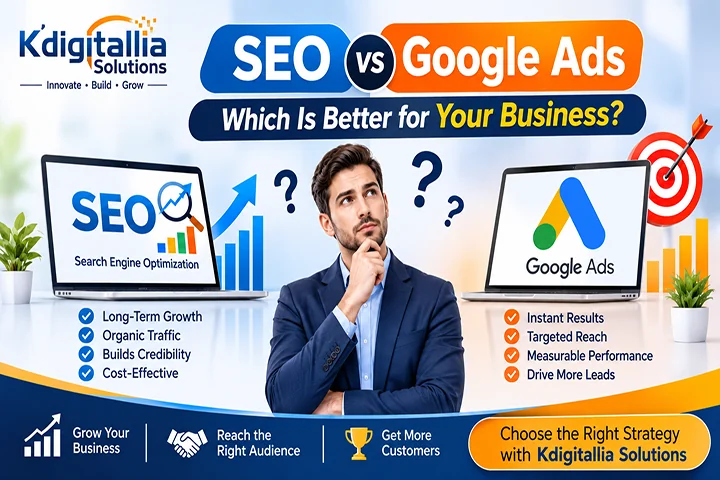
SEO vs Google Ads: Which Is Better for Your Business ?
Introduction: Should You Invest in SEO or Google Ads to Grow Your Business?
Every business wants more customers, more enquiries, better brand visibility, and higher revenue.
Today, when customers need a product or service, one of the first things they do is search on Google.
Whether someone is searching for a website development company, a real estate consultant, an educational institute, a restaurant, or an online shopping platform, Google has become an important destination for discovering businesses.
But how can your business appear in front of these potential customers?
There are two popular ways to increase your visibility on Google:
Search Engine Optimization (SEO) – Improving your website to appear in Google's organic search results.
Google Ads (Paid Advertising) – Paying to display advertisements to people searching for relevant products or services.
Both strategies can help businesses attract potential customers, but they work differently.
So, the important question is:
SEO vs Google Ads – Which is better for your business?
Should you invest in SEO for long-term organic growth, or should you run Google Ads to generate enquiries quickly?
At Kdigitallia Solutions, we help businesses strengthen their online presence through professional website development, SEO, digital marketing, and advertising solutions.
In this article, we will explain both strategies, compare their advantages and disadvantages, and help you understand which approach may be suitable for your business.
1. What Is SEO (Search Engine Optimization)?
SEO stands for Search Engine Optimization.
It is the process of improving your website's content, technical structure, user experience, and online reputation to increase its visibility in organic search engine results.
For example, imagine you own a web development company in Delhi.
When someone searches on Google for:
Website development company in Delhi.
Professional web development services.
Custom web portal development company.
Affordable website development services.
You would want your website to appear among the relevant search results.
SEO helps your website compete for these positions without paying Google for every organic click.
How Does SEO Work?
SEO involves several activities:
1. Keyword Research
Identifying the search terms that your potential customers use when looking for your products or services.
2. On-Page SEO
Optimizing website content, headings, page titles, meta descriptions, images, and internal links.
3. Technical SEO
Improving website performance, mobile responsiveness, crawlability, indexing, website security, and technical structure.
4. Content Marketing
Publishing informative blog posts, guides, service pages, and other useful content.
5. Off-Page SEO
Building your website's reputation through relevant backlinks, genuine brand mentions, and industry relationships.
6. Local SEO
Improving your business visibility in relevant local searches and Google Maps through accurate business information and an optimized Google Business Profile.
Advantages of SEO
Helps attract organic website traffic.
Builds long-term online visibility.
Can reduce dependence on paid advertising.
Improves website credibility and brand awareness.
Helps attract customers actively searching for your services.
Supports local and national business growth.
Creates long-term value through useful website content.
Disadvantages of SEO
Requires consistent effort and patience.
Competitive keywords can be difficult to rank for.
Results are not guaranteed.
Search engine algorithms and competitors can affect rankings.
Requires regular content and technical improvements.
Best suited for: Businesses looking for sustainable organic traffic, long-term online visibility, brand authority, and consistent customer acquisition.
2. What Is Google Ads?
Google Ads is Google's online advertising platform that allows businesses to promote their products and services through paid advertisements.
Unlike SEO, where you compete for organic search visibility, Google Ads allows eligible advertisers to display sponsored advertisements based on campaign settings, targeting, and Google's advertising auction.
For example, imagine a customer searches for:
"Best digital marketing company in Delhi."
If your business runs a relevant Google Search campaign, your advertisement may appear in the sponsored results.
This gives your business an opportunity to reach potential customers who are actively searching for relevant services.
Different Types of Google Ads
1. Google Search Ads
Text-based advertisements that can appear when people search for relevant keywords.
Example: A website development company can advertise for searches related to website development services.
2. Google Display Ads
Visual advertisements that can appear across eligible websites and applications within Google's Display Network.
3. YouTube Ads
Video advertisements that help businesses promote products, services, and brands through YouTube.
4. Google Shopping Ads
Product-focused advertisements that display information such as product images, prices, and merchant details for eligible e-commerce campaigns.
5. Performance Max Campaigns
Campaigns designed to help advertisers reach customers across Google's advertising channels through automated campaign optimization.
Advantages of Google Ads
Can generate advertising visibility quickly after campaigns are approved and become eligible.
Helps target specific locations and audiences.
Provides flexible advertising budgets.
Offers measurable campaign performance.
Can generate enquiries and website visits.
Supports different advertising formats.
Allows businesses to test different keywords, advertisements, and landing pages.
Disadvantages of Google Ads
Requires an ongoing advertising budget.
Competitive keywords can be expensive.
Traffic generally reduces when advertising stops.
Poorly configured campaigns can waste money.
Advertising clicks do not guarantee sales.
Requires regular monitoring and optimization.
Best suited for: Businesses looking for faster promotional visibility, product launches, seasonal campaigns, immediate lead-generation opportunities, and targeted advertising.
3. SEO vs Google Ads: Complete Comparison
Let's compare SEO and Google Ads based on important business requirements.
| Comparison | SEO | Google Ads |
|---|---|---|
| Marketing type | Organic | Paid |
| Traffic cost | No payment per organic click | Advertising charges apply |
| Visibility | Builds over time | Can start quickly |
| Results | Generally long-term | Campaign-dependent |
| Budget | SEO investment required | Advertising budget required |
| Brand authority | Builds organic credibility | Builds sponsored visibility |
| Keyword targeting | Organic keyword optimization | Paid keyword targeting |
| Traffic after stopping | Existing rankings may continue | Paid campaign traffic generally stops |
| Competition | Organic ranking competition | Advertising auction competition |
| Best for | Sustainable growth | Faster campaign visibility |
Both strategies offer different advantages. Neither is automatically better for every business.
The right choice depends on your objectives, competition, budget, and customer acquisition strategy.
4. SEO vs Google Ads: Which One Is More Cost-Effective?
Cost is one of the biggest considerations for businesses planning their digital marketing budget.
Let's understand how the two strategies differ financially.
SEO Investment
SEO generally involves investment in:
Website optimization.
Keyword research.
Content development.
Technical SEO.
Link-building activities.
SEO audits.
Performance monitoring.
SEO does not require paying Google for every organic click.
However, professional SEO requires time, expertise, and ongoing resources.
Once your website earns strong organic visibility, it can continue attracting visitors without paying for each individual organic visit.
Google Ads Investment
Google Ads generally uses an auction-based advertising model.
Depending on the campaign type, advertisers may pay for clicks, impressions, conversions, or other advertising interactions.
Your overall cost can depend on:
Keyword competition.
Industry.
Target location.
Advertising quality.
Bidding strategy.
Campaign settings.
Landing page experience.
For example, businesses operating in highly competitive industries may need larger advertising budgets to compete effectively.
Which Is More Affordable?
SEO may offer better long-term value for businesses that can invest in consistent optimization and wait for organic results.
Google Ads may be more suitable when a business wants to generate visibility within a shorter timeframe and has a budget for paid campaigns.
Our recommendation: Evaluate the cost of acquiring an actual customer, not just the cost of getting a website visitor.
A campaign that generates fewer but more qualified enquiries may be more valuable than one that generates hundreds of irrelevant clicks.
5. When Should Your Business Choose SEO?
SEO is particularly useful when your business wants to build a long-term digital presence.
You should consider SEO if:
A. You Want Consistent Organic Website Traffic
If customers regularly search for your products or services, SEO can help your website compete for relevant searches.
B. You Want to Build Brand Authority
Publishing useful content and maintaining a strong organic presence can help establish your business as a credible source of information.
C. You Want to Reduce Long-Term Dependence on Paid Advertising
Strong organic visibility can provide another source of website traffic alongside paid marketing campaigns.
D. You Operate a Service-Based Business
Businesses such as IT companies, consultants, educational institutions, real estate agencies, and professional service providers can benefit from ranking for relevant service-related searches.
E. You Want to Grow Your Local Business
Local SEO can help businesses improve their visibility when nearby customers search for relevant products or services.
6. When Should Your Business Choose Google Ads?
Google Ads can be useful when your business needs faster advertising visibility.
Consider Google Ads if:
A. You Are Launching a New Business
A new business may not have established organic search visibility.
Paid advertising can help introduce your products and services to potential customers while your website's organic presence develops.
B. You Are Promoting a Special Offer
If you are running a seasonal promotion, discount campaign, admission campaign, or product launch, paid advertisements can help generate awareness.
C. You Want to Generate Leads Quickly
For businesses that depend on customer enquiries, targeted Search campaigns can help reach people actively looking for relevant services.
D. You Want to Target Specific Locations
A business serving customers in selected cities or geographical areas can configure campaigns to reach relevant locations.
E. You Want to Test Market Demand
Google Ads can help test different keywords, offers, landing pages, and audience segments before making larger marketing investments.
7. Can You Use SEO and Google Ads Together?
Absolutely!
In fact, using SEO and Google Ads together can be an effective digital marketing strategy.
Instead of treating them as competing marketing channels, businesses can use them to support different stages of customer acquisition.
Consider this example.
Imagine you operate a web development company.
You want to attract customers searching for:
Custom website development.
E-commerce website development.
ASP.NET Core development.
Web portal development services.
Here is how both strategies can work together.
SEO Strategy
Create optimized service pages.
Publish informative technology blogs.
Target relevant keywords.
Improve technical website performance.
Build relevant backlinks.
Improve local search visibility.
Google Ads Strategy
Run Search campaigns for high-intent keywords.
Promote specific development services.
Target relevant geographical locations.
Create dedicated landing pages.
Track calls and enquiry form submissions.
Optimize campaigns based on qualified leads.
Combined Benefits
Paid advertisements can provide visibility while SEO develops.
Organic and paid channels can reach different search opportunities.
Keyword insights from advertising can inform content planning.
Businesses can test landing pages and marketing messages.
Multiple marketing channels can strengthen brand presence.
However, combined marketing should be managed according to business profitability and actual campaign performance.
8. Real Business Examples: SEO vs Google Ads
Let's understand how different businesses can benefit from these strategies.
Example 1: A Local Retail Store
Imagine you own a furniture showroom in Delhi.
SEO Strategy:
Optimize your Google Business Profile.
Create a website showcasing furniture collections.
Publish useful articles about furniture selection.
Target location-specific search terms.
Google Ads Strategy:
Promote special discounts.
Advertise selected furniture categories.
Target customers in nearby locations.
Expected business objective: Increase local visibility and encourage showroom visits.
Example 2: An Educational Institute
Imagine you operate a coaching centre or educational institution.
SEO Strategy:
Create course-specific pages.
Publish educational content.
Optimize admission-related search terms.
Improve local search visibility.
Google Ads Strategy:
Run admission campaigns.
Promote upcoming courses.
Generate student enquiry forms.
Advertise in selected locations.
Expected business objective: Increase admission enquiries and attract prospective students.
Example 3: An E-Commerce Business
Imagine you sell products through an online store.
SEO Strategy:
Optimize product pages.
Create category descriptions.
Publish product guides.
Improve internal linking.
Google Ads Strategy:
Run Shopping campaigns where eligible.
Advertise popular products.
Promote special offers.
Remarketing to relevant audiences.
Expected business objective: Increase qualified product traffic and online sales.
Example 4: An IT and Software Development Company
SEO Strategy:
Create individual service pages.
Publish technical articles.
Target industry-specific keywords.
Develop informative case studies.
Google Ads Strategy:
Advertise custom software development.
Target relevant business searches.
Promote web portal development services.
Generate project enquiries.
Expected business objective: Generate relevant business leads and new development projects.
9. Common Mistakes Businesses Should Avoid
Whether you choose SEO, Google Ads, or both, certain mistakes can negatively affect your marketing results.
Common SEO Mistakes
Targeting irrelevant keywords.
Publishing copied or low-quality content.
Ignoring technical SEO.
Having a slow or poorly designed website.
Ignoring mobile users.
Building spammy backlinks.
Expecting immediate organic rankings.
Not monitoring search performance.
Common Google Ads Mistakes
Selecting irrelevant keywords.
Targeting locations outside your service area.
Sending visitors to poorly designed landing pages.
Not tracking conversions.
Using broad targeting without proper controls.
Ignoring negative keywords.
Spending without monitoring campaign performance.
Focusing on clicks instead of qualified leads and sales.
Important: A successful marketing campaign requires more than traffic. Your website should convert relevant visitors into genuine business enquiries and customers.
10. Why Your Website Plays an Important Role in SEO and Google Ads
Whether you invest in SEO or Google Ads, your website is one of the most important components of your digital marketing strategy.
Think about it.
You spend money on advertising or invest time in SEO to attract visitors.
But what happens when those visitors reach your website?
If your website is slow, difficult to navigate, outdated, or unclear about your services, potential customers may leave without contacting you.
That is why your website should be designed to support marketing objectives.
A professional business website should include:
Responsive mobile-friendly design.
Fast page loading.
Clear service information.
SEO-friendly page structure.
Secure HTTPS connection.
Easy navigation.
Contact forms.
Click-to-call facilities.
Strong calls to action.
Proper analytics and conversion tracking.
At Kdigitallia Solutions, we understand the connection between website development and digital marketing.
We develop customized websites and web portals that can provide a strong foundation for SEO and paid advertising campaigns.
Our development technologies include ASP.NET Core, PHP Laravel, Python, and modern frontend technologies, depending on the project requirements.
11. How Kdigitallia Solutions Helps Your Business Grow with SEO and Google Ads
At Kdigitallia Solutions, our objective is to help businesses establish a professional online presence, reach relevant customers, and create more opportunities for growth.
We understand that every business has different marketing requirements.
A startup may need brand awareness, a local business may need more customer visits, an educational institution may need admission enquiries, and an e-commerce company may want more online sales.
That is why we focus on business-oriented digital solutions.
A. Professional Website Development
We develop customized, responsive, and professional websites for businesses across different industries.
Our services include:
Corporate website development.
Business website development.
E-commerce website development.
Custom web portal development.
Educational portal development.
Real estate portal development.
Travel and tourism portal development.
Customized business applications.
We focus on creating websites with SEO-friendly architecture, user-friendly navigation, and scalable functionality.
B. Search Engine Optimization Services
We help businesses improve their organic search visibility through:
SEO audits.
Keyword research.
On-page SEO.
Technical SEO.
Content optimization.
Local SEO.
Internal linking.
Quality backlink strategies.
Search performance monitoring.
Our goal is to help your business become more discoverable when potential customers search for relevant products and services.
C. Google Ads and Paid Advertising
We help businesses explore paid advertising opportunities to reach relevant audiences.
Our campaign services can include:
Google Search Ads.
Display advertising.
YouTube advertising.
Lead generation campaigns.
Location-based advertising.
Keyword targeting.
Campaign performance monitoring.
We focus on aligning advertising campaigns with your business objectives and available budget.
D. Social Media Marketing
Social media is an important part of modern business promotion.
We help businesses strengthen their brand presence through:
Facebook marketing.
Instagram marketing.
LinkedIn marketing.
YouTube promotional content.
Social media creatives.
Promotional videos.
Brand awareness campaigns.
E. Digital Branding and Advertising
We help businesses communicate their identity through professional digital promotional materials.
Our services can include:
Business promotional banners.
Social media graphics.
Promotional videos.
Corporate introduction videos.
Digital advertising creatives.
Marketing content.
F. Mobile Application Development
We develop customized mobile applications that help businesses connect with customers and improve their digital services.
Applications can include customer accounts, product catalogues, booking facilities, notifications, and other business-specific functionality.
G. AI Integration and Business Automation
We also help businesses explore modern AI-powered solutions, including:
Intelligent chatbots.
Automated customer assistance.
AI-powered search.
Customized business applications.
Workflow automation.
Intelligent information systems.
Our objective is to help customers use technology to improve their business processes and customer experiences.